Artigo dos voluntários do Corpo Europeu de Solidariedade
Este mês partilhamos um artigo da autoria de um voluntário do projeto Corpo Europeu de Solidariedade – Volunteer Escapes. Os conteúdos partilhados resultaram do seu projeto de pesquisa de campo e bibliográfica, com o objetivo de fazer comunicação de ciência e divulgação dos trabalhos realizados aquando do seu voluntariado na Associação.
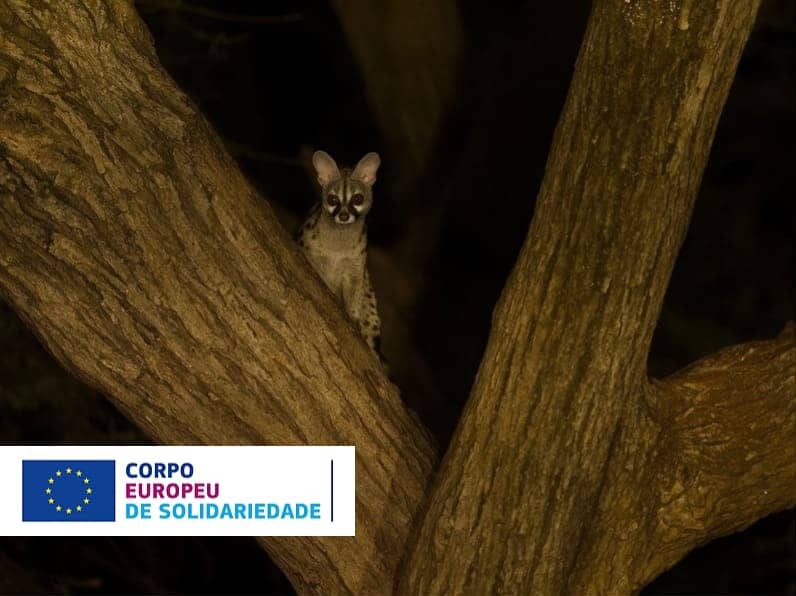
“The genet (Genetta genetta) is one of the most common wild mammals in mainland Portugal, although it is rarely seen. Originally brought to Europe from Africa centuries ago, it is now viewed as part of the local wildlife. Roughly the size of a domestic cat, the genet has a long, slender body covered in greyish-brown fur dotted with dark spots and marked by a black stripe running down its back. Its long, ringed tail, pointed snout, and triangular ears give it a cat-like appearance, while the white markings beneath its eyes make it particularly distinctive.
The solitary animal is primarily active during the night, when it hunts. Its main source of food is the wood mouse and other small mammals and vertebrates like birds and reptiles, but it also feeds on insects, eggs or fruits. Highly agile, genets use their semi-retractable claws to climb trees and are skilled jumpers and swimmers. Apart from urine, genets produce smelly secretions from their perineal gland to signal social and sexual information.
Habitat
The genet is very adaptable and thrives in various habitats. As a result, the species occurs throughout the whole of Portugal. It prefers forested areas high in vegetation and understory cover but also vegetated rocky areas, particularly in landscapes close to water. In Europe, they are commonly found in oak, ash, and pine forests, as well as vegetated riparian corridors. They can also inhabit olive groves, eucalyptus plantations, vineyards and populated areas. It avoids open areas, marshes, and agricultural fields which make it vulnerable to predators. During the day, genets rest in well-concealed shelters, including dense vegetation, rocky crevices, hollow trees, treetops, and vegetation-lined burrows. They typically change resting sites daily.
Conservation status
Due to its generalist habits concerning food and habitat and therefore wide distribution, the genet population is not endangered. Although it is a species of “Least Concern”, in regards to its conservation status in Portugal and worldwide on the IUCN Red List, it is protected under EU law. It is listed in Appendix III of the Bern Convention and Annex V of the Habitats and Species Directive, ensuring a favorable conservation status. In general, no special actions have been taken to keep its population stable in Portugal so far, except for the restriction of forestry operations around nests and burrows to minimize disturbances to these sites. Despite this, habitat loss is a threat for the species and further promotes its advances into populated areas which elevates its risk of being killed in car accidents. A possible measure to reduce this risk is the active improvement of the genets habitats and the establishment of areas designated to its conservation. Unfortunately, dense vegetation and shrubs, which are the preferred habitat of the genet, pose an increased fire risk. Moreover, the construction of ecological corridors connecting habitats enables genets to pass safely from one habitat into another and links different populations to promote genetic diversity.
Genets have been recorded in planted forests in Pampilhosa and Mortágua in central Portugal during the WildForests scientific project. Its presence in the nearby Bussaco National Forest and in Sintra-Cascais Natural Park, where Plantar uma Arvore is active in nature conservation, is confirmed, as the dense vertical vegetation and many water sources may present the preferred habitat for the species.”
Autoria: Eva-Marie Dutscho