Artigo dos voluntários do Corpo Europeu de Solidariedade
Este mês partilhamos um artigo da autoria de um voluntário do projeto Corpo Europeu de Solidariedade – Volunteer Escapes. Os conteúdos partilhados resultaram do seu projeto de pesquisa de campo e bibliográfica, com o objetivo de fazer comunicação de ciência e divulgação dos trabalhos realizados aquando do seu voluntariado na Associação.
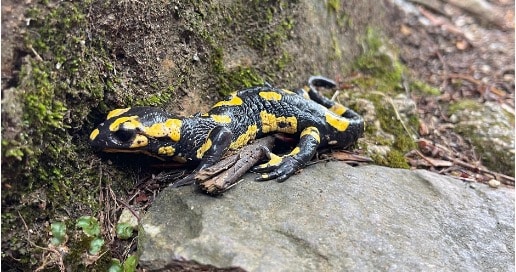
The “Salamandra salamandra, commonly known as the fire salamander, is a large and eye-catching species of salamander found across central and southern Europe, extending into parts of northern Africa and western Asia.
The name “salamander” originates from an Arab term meaning “lives in fire,” a myth likely stemming from the animal’s frequent appearance crawling out of logs thrown into fires, despite its lack of fire resistance. The species is also known by Portuguese regional names such as salamandra-de-pintas-amarelas, salamântega, saramântiga, or saramela. It has been used in the pet trade and as a model organism (a non-human species extensively studied in a laboratory setting to understand specific biological phenomena) in research, though conservation efforts and better legislation have helped reduce wild collection.
Despite its wide distribution and abundance, the species is classified as Vulnerable on the IUCN Red List due to the threat posed by the introduced chytrid fungus Batrachochytrium salamandrivorans, which has caused severe population declines in parts of its range. The Iberian Peninsula hosts a high diversity of lineages, with up to nine described subspecies, each displaying distinct color patterns and reproductive strategies.
It is characterized by its black body with variable yellow, orange, or red markings, which serve as aposematic coloration to warn predators of its toxicity. The species can grow up to 25 cm in body length, sometimes reaching nearly 30 cm, with a robust, cylindrical tail shorter than the body and chunky limbs. The skin is smooth and shiny, with visible parotoid glands behind the eyes and a row of poison glands along each side of the body, producing the neurotoxin samandrina.
Fire salamanders are in fact toxic to humans too, but not typically dangerous with proper precautions. The neurotoxin can cause muscle convulsions, hypertension, and hyperventilation if ingested or exposed to mucous membranes. Casual skin contact however is usually not life-threatening but may cause irritation, especially if toxins enter through cuts or are transferred to eyes, nose, or mouth. per definitions, They are not venomous (do not inject toxin via bite), but their secretions act as a chemical defence when threatened.
The fire salamander inhabits deciduous and mixed forests, preferring shaded, moist environments near streams or ponds for breeding. Mata do Bussaco is consequently an ideal habitat for this and many other amphibians. It is primarily nocturnal and spends much of its time hidden under logs, rocks, or in crevices to avoid desiccation and predation. It demonstrates strong site fidelity, often returning to the same overwintering sites for many years, with some individuals documented to return to the same cave for up to 20 years. Longevity in the wild can reach up to 30 years, though some individuals in captivity have lived over 50 years.
Its diet consists mainly of invertebrates such as earthworms, slugs, beetles, and various arthropods, with hunting strategies adapting to light conditions – using vision in well-lit areas and olfaction in darkness.
Salamandra salamandra is typically viviparous, with females giving birth to fully developed larvae in shallow, fishless brooks, usually between September and May. The number of offspring per female ranges from 20 to 40, though this varies among subspecies. In some populations, particularly in the Iberian Peninsula, females may give birth to fully metamorphosed juveniles rather than aquatic larvae, a reproductive shift observed in subspecies like S. s. Bernardezi. The species exhibits little sexual dimorphism, though females are generally larger than males, and differences become more apparent during the breeding season.”
Autoria: voluntária Océane Jaritz