Artigo dos voluntários do Corpo Europeu de Solidariedade
Este mês partilhamos um artigo da autoria de um voluntário do projeto Corpo Europeu de Solidariedade – Volunteer Escapes. Os conteúdos partilhados resultaram do seu projeto de pesquisa de campo e bibliográfica, com o objetivo de fazer comunicação de ciência e divulgação dos trabalhos realizados aquando do seu voluntariado na Associação.
“Today, we are going to focus on a fascinating plant species native to Portugal : Ophrys sphegodes.
Scientifically speaking, this plant belongs to the Orchidaceae family. This term refers to perennial, herbaceous, terrestrial plants generally characterized by clusters or solitary, brightly colored flowers.
Ophrys sphegodes is classified as EN (Endangered) at the national level on the IUCN Red List, which means that its survey is clearly jeopardized.
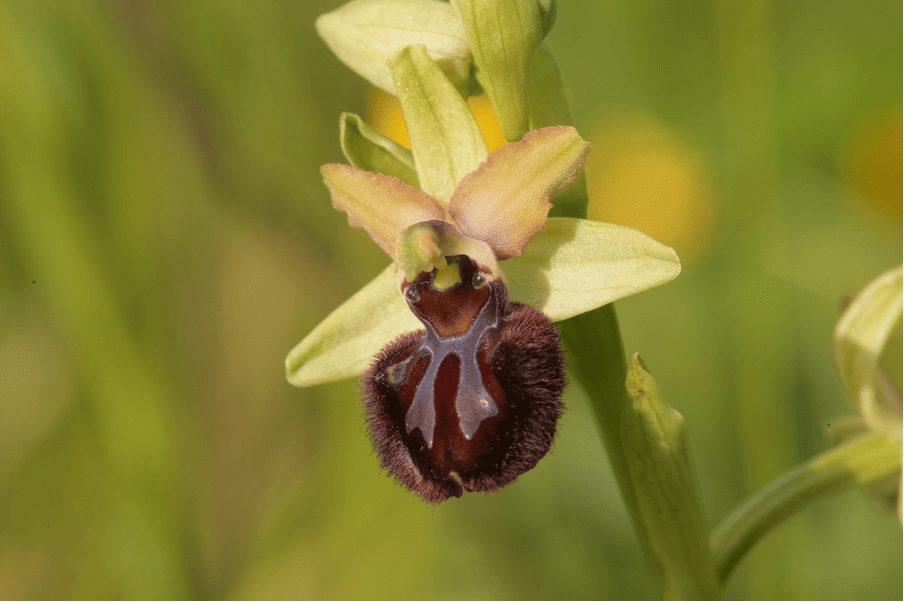
It blooms between March and May/June. It measures between 10 and 35cm, has long green leaves and a velvety, purple-brown and yellow labellum (upper petal), which looks like a spider, hence the plant’s name.
It grows on alkaline (basic), dry and stony soils. Its preferred habitats are the pastures, meadows and clearings in crops and forests.
At the national level, this Ophrys is widespread in the Mediterranean basin, more specifically in the Arrábida and São Luis mountains ; Baixo Alentejo ; and Alto Alentejo. At the world level, you can find it in Central and Southern Europe but also in Algeria.
Although there is no accurate estimate of the national population size, the most recent observations suggest that it should not exceed 250 mature individuals in total, in Portugal. The plant has a small area of occupancy (80 km²) and only five locations have been identified. There has been a continuous decline in the size, quality, and extent of its habitat.
A fun fact about this plant is that, like most of the Orchidaceae, Ophrys sphegodes uses a pseudocopulation process in order to ensure pollination, tricking the males of certain wild bees. In this case, it is a visual and olfactory strategy. Indeed, the labellum resembles the abdomen and pseudo-eyes of a spider and smells like a female insect.
This specificity contributes to the richness of the ecosystems where it is found, as the plant attracts specific insects and promotes pollination. Its presence can therefore be an indicator of habitat diversity.
Unfortunately, the population of Ophrys sphegodes is threatened in Portugal. The main cause is the expansion of intensive agriculture, which is expected to continue in the coming years and particularly affect the populations of Alentejo.
Fortunately, all is not lost. Several ecological measures can be taken to protect this species. Here are a few:
a) limit interventions and trampling, and, if interventions must be done, use light and manual machinery in order to preserve areas occupied by the plant;
b) carry out maintenance, by mowing, in the habitat to limit overgrowth and excessive grass cover;
c) implement awareness-raising actions among landowners and institutions in order to avoid the extermination of the plant;
d) it is also feasible to resort to ex situ conservation, focusing on population centers whose destruction seems inevitable in the short term.
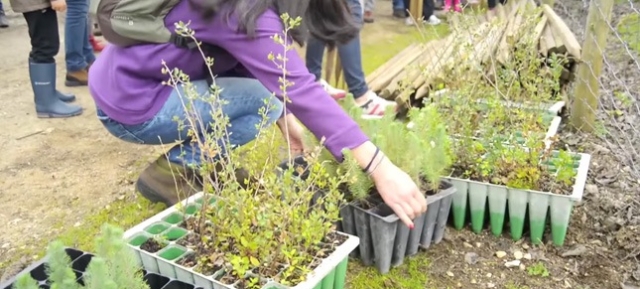
Plantar Uma Árvore is involved in the preservation of vulnerable flora. Thus, the organization sometimes retintroducts locally extinct plant species. This is an example of operations that are indispensable for the prosperity of biodiversity.
As a final word, if you, dear reader, happen to come across an Ophrys sphegodes, don’t forget to treat it with care, admire its beauty if you want, leave it in its natural habitat and don’t damage it 🌱
* perennial plant : a plant that lives for more than two years
* IUCN Red List : an international inventory of the global conservation status of plants, fungi and animals
* pseudocopulation : attempted copulation by a male insect with a flower that resembles the female, carrying pollen to it in the process.”
Author: volunteer Noémie Huin