Artigo dos voluntários do Corpo Europeu de Solidariedade
Este mês partilhamos um artigo da autoria de um voluntário do projeto Corpo Europeu de Solidariedade – Volunteer Escapes. Os conteúdos partilhados resultaram do seu projeto de pesquisa de campo e bibliográfica, com o objetivo de fazer comunicação de ciência e divulgação dos trabalhos realizados aquando do seu voluntariado na Associação.
“The Portuguese system of protected areas is characterized by a diversity of statuses that reflects a graduated and territorialized approach to conservation, ranging from strict protection of ecological processes to the conscious integration of human uses. Their geographical distribution is shown in the following map:
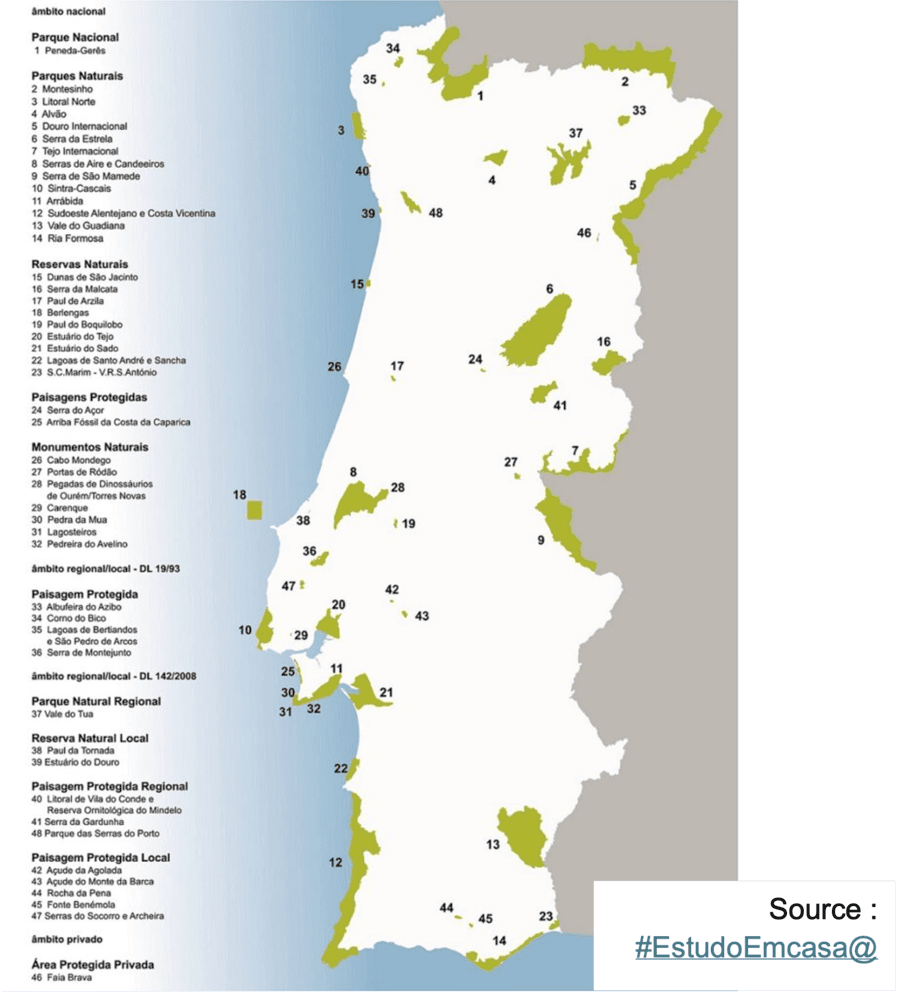
The only existing National Park (Peneda-Gerês) plays a central role in conservation, aiming to preserve complete and functional ecosystems that serve as scientific references.
Protected landscapes (Paisagen(s) protegida(s)) recognize the ecological and cultural value of territories shaped by historical interaction between human societies and natural environments, making conservation a lever for territorial identity and the continuity of traditional practices.
Natural Monuments (Monumentos Naturais) ensure the specific protection of exceptional geological, paleontological or biological features that are essential to scientific knowledge and awareness, while private protected areas extend conservation to non-public land.

The DL 142/2008 law has from duplicated this classification to the local scale. That’s why it is possible to encounter Reserva(s) Natural(es) Local(is) below simple natural reserves, and so on with other types… Their existence is beyond that law, the result of a decentralization process of nature conservation areas declension, in which municipalities apply classification, and gestion of those sites as delegated competences from the Portuguese estate.
Outlier areas can be added, like “private protected areas” (Áreas Protegidas Privadas) that enable private landowners to legally manage areas of significant natural value in accordance with appropriate management and protection measures, extended to private land. This is to find, for instance, in Vale das Amoreiras whose the gestion is devolved to two citizens of Aljezur (RWSW Rewilding Sudoeste – Associação de desenvolvimento da natureza e ambiente).
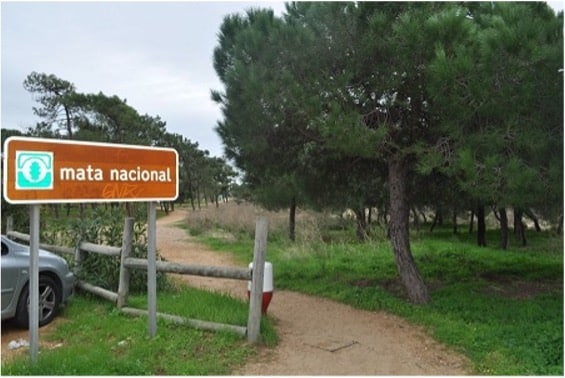
Matas nacionais can also be classified hereby as a forestry and ecological management instrument of public interest, ensuring sustainable management, conservation of natural values and public ecological functions, where private initiative alone cannot meet these challenges. They consist in a designation for areas that have been privately ruled and intervened and then now under the management (or co-management) of the State (ICNF) (Alves et Carvalho, 2017), going in hand with local partner (see the example below).
Nature conservation policies in France can be, in some oppositions to Portugal, seen as a complex stratified system, defined according to Environmental Code, Urbanism Code, and the Forestry Code.
Conservation can be ensured by pragmatic entities, well-delimited in space called conservation perimeters. Those can act as a surface of :
- Protection (dispositifs de protection) – According to the International Union for Conservation of Nature (IUCN), a protected area is “a clearly defined geographical space, recognized, dedicated and managed, through effective legal or other measures, to achieve long-term conservation of nature and associated ecosystem services and cultural values“. The designation of protected natural areas is a major component of natural heritage protection and management strategies. As such, there are various protection tools in France, the diversity of which reflects the multiplicity of stakeholders, objectives and possible types of management. These various protection tools are as such, subdivided according to that diversity listed as follows:
| Type | Diversity illustration : declension of existing spaces | Features |
| Regulatory Facilities created by a regulatory act (decree or order) that aim to prohibit or limit human activities that are harmful to remarkable biodiversity in terrestrial or marine areas | APB, APHN (Biotope protection ordinance, Natural Habitat Protection Order) | Defined by the state head-representative at district level |
| National parks | Highest level of conservation | |
| Réserves biologiques integrales(Integral biological reserves) | Protections dedicated to public forests | |
| Réserve nationale de chasse et faune sauvage (National Hunting and Wildlife Reserve) | Wildlife conservation area through strict hunting regulations | |
| Natural reserves (national, regional, and Corsica ones) | Subjecting any action likely to harm the natural development of fauna and flora of local importance to special regulations or prohibitions. | |
| Contractual Documents that define regional management measures aimed at reconciling the preservation of natural heritage with the economic, social and cultural development of the regions concerned. | Parcs naturels régionaux – Regional Natural Parks | Conciliation in such territories between economical development and nature conservation. Widest ones to find then. |
| Landowning Publicly acquired or compromised areas (due to their fragility or vulnerability from an ecological point of view), to ensure their protection in the medium, long term or permanently. | Conservatoire du littoral – Coastal protection agency | Owned by public organizations, to protect coastal areas, in which natural areas are more pressured than anywhere else |
| Conservatoire des espaces naturels – Natural protection agency | Owned by associations | |
| Obligations réelles environnementales – Effective environmental liabilities | Owned by private landowners | |
| Espace naturel sensible – Sensitive natural area | Owned by districts |
Natura 2000 areas are according to that system in contractual and international-stated conservation perimeters.
Conservation perimetries can also be found in surfaces of :
“Inventory” (périmètres d’inventaire) – Those perimeters represent a tool for knowledge of French natural heritage, allowing a delineation of areas as well of ecological interest within territories. One can find attached to this type the :
- Atlas de biodiversité communale (ABC) – local biodiversity atlas : a full-taxa inventory made within a municipality, involving citizens and associations in its completion
- Zone naturelle d’inventaire écologique faunistique et floristique (ZNIEFF) – : an area of land that is particularly interesting from an ecological point of view, contributing to the maintenance of the natural balance or providing a habitat for rare animal and plant species characteristic of the region’s natural heritage. Those perimeters of data collection saw a first wave of settings during the 2000s decade, progressively actualized as the time goes by now.
Knowledge is the basis of any action to forecast, that’s why having them also represents a pillar of the French conservation areas web.
Indeed, the simple presence of a particular species confirmed in a specific field will greatly influence the fate and possible trajectories of that field compared to the land management aim and local ambitions to reshape some landscapes. If such a presence doesn’t directly label an area as natural, and leave unused, that at least add up many administrative procedures to follow to change a land use, slowing then the pace of anthropization pressure in a territory.
Conservation policies in France are ensured in actions that do not specifically rely on concrete surfaces. Actions following those policies can be framed through territorial schemes, thus transcending natural boundaries.
- Strategic framework documents : A ‘flexible’ regulatory framework that is not directly enforceable but provides a structure for all other documents relating to biodiversity management. They have the aim to point out direction, priorities and overall objectives to any other document, to be directly in line with international and European commitments in conventions of the country, in matter of biodiversity. One can find in this type, overall, the Biodiversity National Strategy (Stratégie Nationale de Biodiversité), and Protected Areas National Strategy (SNAP).
- National Action Plans (PNA) : consist in framework documents focusing on the conservation of a particular endangered species.
The picanços (or shrikes) are for instance a bird genus in which the species’ populations have strongly decreased by the last decades in France. Relying on peculiar habitats, they benefit from more than a decade of that national framework, which favors conservation actors’ coordination and fundings across the country.
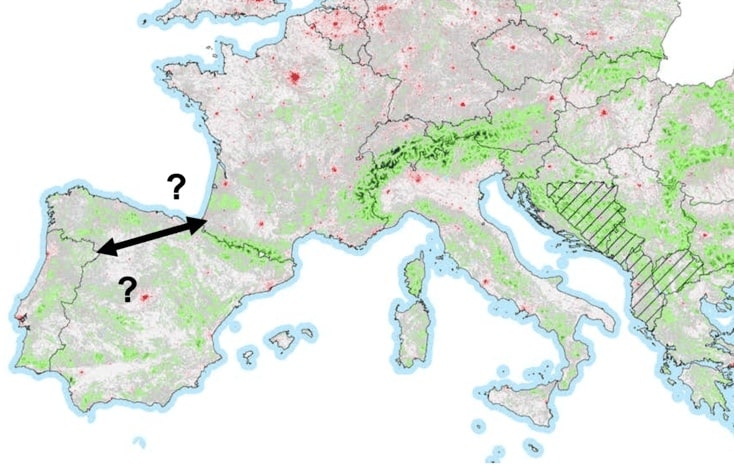
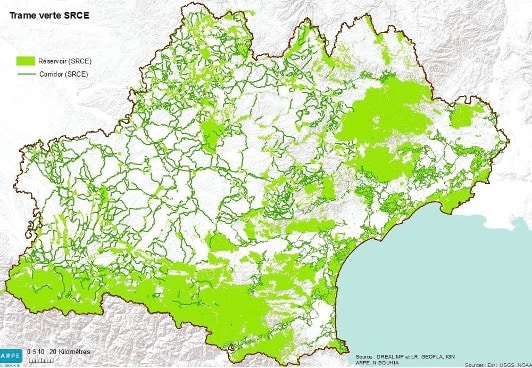
Territorialized ecological planning documents; which make up the bind between national strategy and local planning, often indirectly in a prescriptive way. This is where biodiversity begins to be put on the map. We found here the regional version of the biodiversity framework, and the green infrastructure (trame verte). A regional perspective on protection mapping towards can be offered in a “SRCE”, like in the enclosed extract.
Such maps observe a great scale flexibility, so much so that the green infrastructure borders can be delimited from the region scale to meter-like scale with many intermediate ones (to see in green in both following maps) :
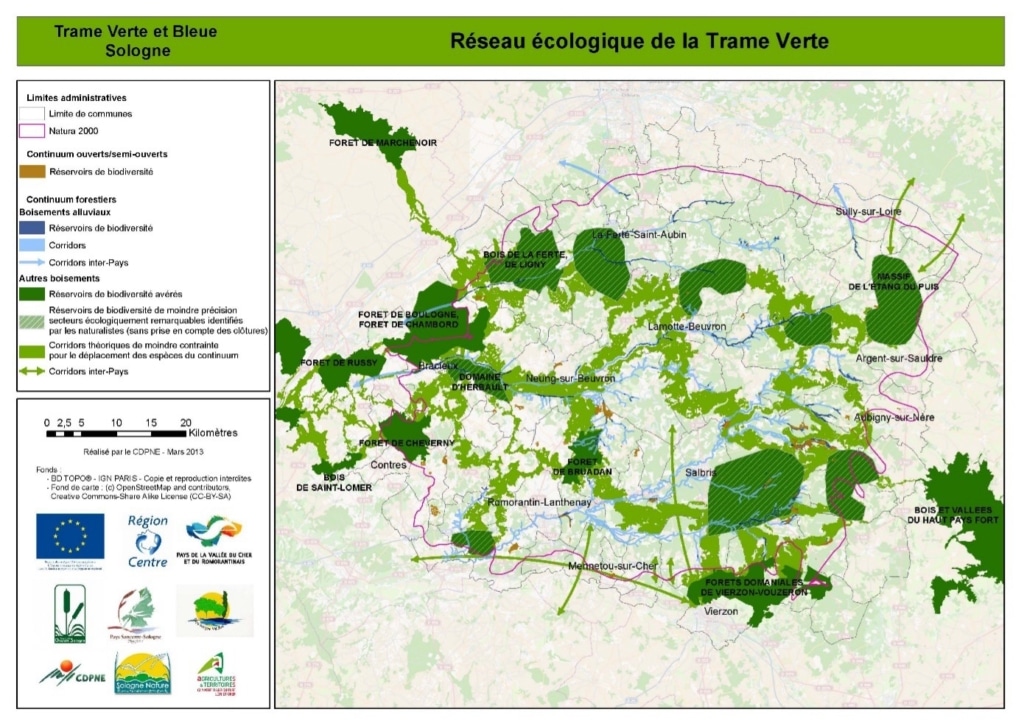
Urban planning and development documents are finally to be found in the regulatory translation, arbitration between biodiversity and development. This is where biodiversity becomes a constraint or a concrete lever for action in land use change. Environmental gestion deals so far here, with urbanism issues.
All of the previous perimeters will be integrated in the natural areas of the planning (written as “N”) and intertwining with reinforced land use stability when talking about protection perimeters and ZNIEFFs, as well as a driving force to land use change decisions (every 6 years), when it comes to the biodiversity atlas.
A dozen perimeter types or subtypes, as well as six territorial schemes can be counted in a summary.
From that, it can be established that Portuguese conservation area system and the French one, share high similarities in components, with only but equivalences of Portuguese areas to be found on the other side, though with a different structuration, way more straight-forward in Portugal by no need to classify in types.
The extra perimeters to find in France must be highlighted due to a more complex administrative division, which create then more entities to place as a gestion one in a conservation area, from a personal perspective.
Not mentioned earlier, same strategies of biodiversity issues integration in local land use gestion can be found in a Plano Diretor Municipal, or PDM, for instance. And the list of equivalence would go on by focusing on landscape-scaled gestion documents…
Biosphere reserves, Ramsar Wetlands of International Importance, World (Natural) Heritage Sites, and Natura 2000 (SIC – Sítio de Importância Comunitária, Zona de Protecção Especial – ZPE) are shared between both countries, as international conservation areas too.
The main difference would to be found in the clear distinction of inventory perimeters in France, and a species-focus possible in both perimeters and schemes as well, out of Natura 2000 areas consideration. Those settings tend to advance a difference between France and Portugal nature conservation made up of intricacies, .
Otherwise, would the main difference between both countries’ areas be in the gestion paradigm by the different stakeholders : their approach ? Is that finally more the experience than the settings that matter in such a comparison ?
That question should be explored and find more answers after current initiatives like the @natuurepeintureproject, or more exploration in the socio-ecosystems topic.
France and Portugal are the very end biogeographically similar : some areas in the very south of France show similar habitats as in Portugal. Therefore, both main intervention areas of the association ; Sintra-Cascais Natural Park and Mata Nacional de Buçaco would easily find their counterpart on their country.
Still from a personal perspective, the first mentioned, in which I’m currently working, makes me remember in some aspects of the Haut-Languedoc Regional Nature Park.
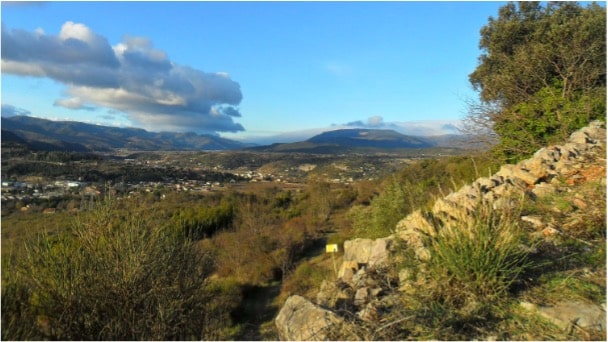
In both territory types and nature conservation systems, the associations are finally deeply involved, by owning the capacity to intervene in some area gestions. Is there by that, a fertile soil through exchanges on a broader scale, in the future? That’s a question I leave to the readers.”

Autoria: Matthis Da Costa